
Reflecting pools
Dark-finished basins engineered to hold a mirror surface with a concealed perimeter overflow.
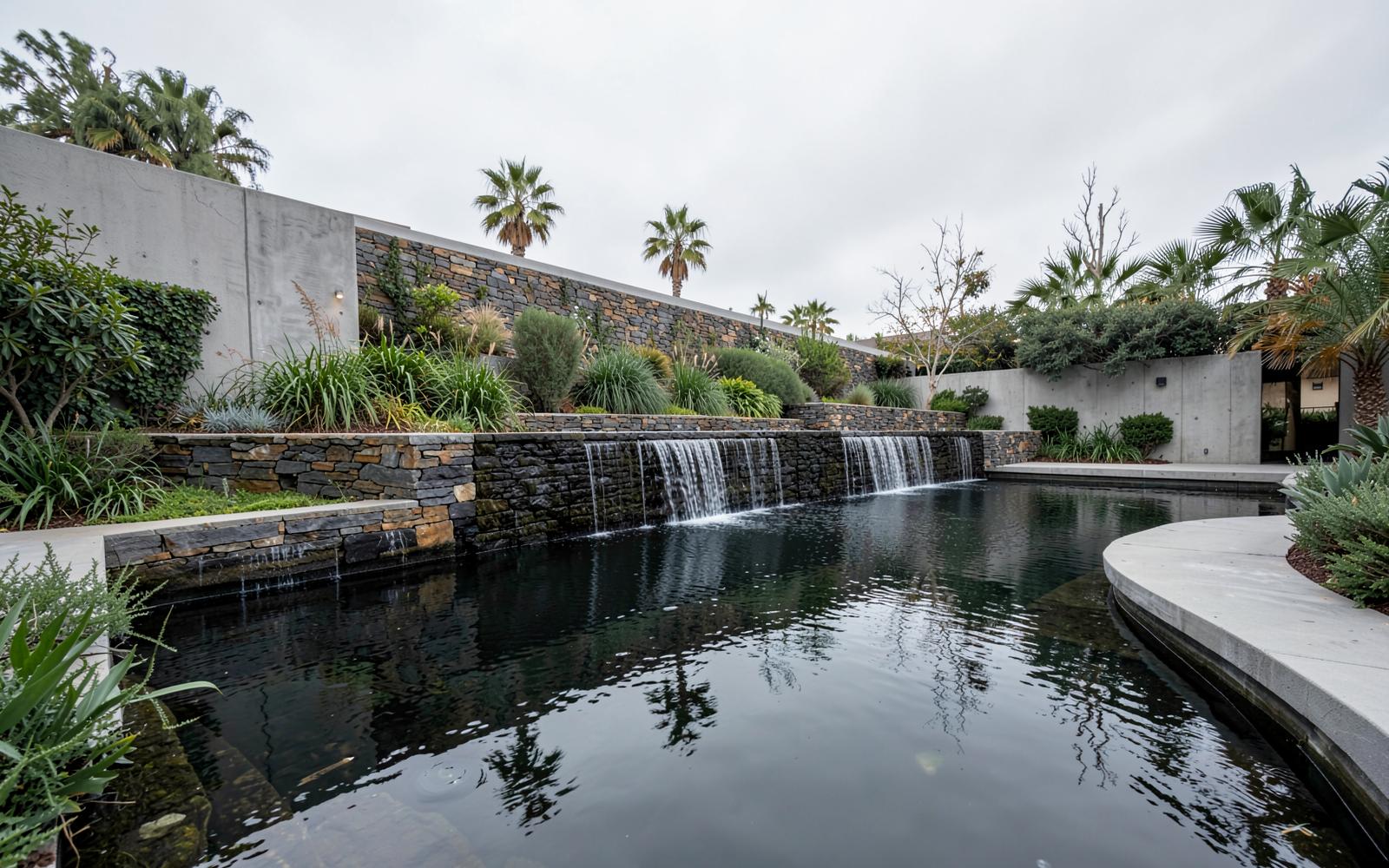
Fountains, runnels, reflecting pools, and scuppers
Reflecting basins, wall scuppers, runnels, and sculptural fountains, engineered so the surface stays quiet and the equipment stays hidden.
Water does two things nothing else can: it reflects the sky and it covers the street. A well-tuned feature can drop the perceived noise of a canyon road to almost nothing.
We tune each feature for a specific sound — a low sheet, a soft break, or complete stillness — and hide every basin, sump, and autofill so the effect appears effortless.
What’s included
Dark-finished basins engineered to hold a mirror surface with a concealed perimeter overflow.
Wall-mounted water walls tuned for volume and break at the flow rates you will actually run.
Narrow channels that carry water through a terrace or along a path.
Stone, corten, and cast basins, sourced or fabricated to the drawings.
Filtration, UV, and autofill sized to keep the water clear without visible hardware.
Submerged and grazing lighting, plus sound tuning against ambient noise.
A perfectly flat sheet of water needs level tolerances measured in millimeters, correct surge volume, and wind considered at design stage. It is the detail most often promised and least often delivered.
Materials & finishes
Dark plaster, black pebble, and honed stone for maximum reflection.
Mitered stone and steel weirs machined for an even sheet.
Corten, blackened steel, and patinated bronze.
Zellige and glass mosaic used where light needs to move.
Common questions
Reflecting pools, scupper and sheet walls, spillover basins, rills, and quiet courtyard fountains — designed as architecture, with the mechanical side hidden and serviceable.
That is a design decision, and we tune it deliberately. Drop height, edge profile, and flow rate determine whether a feature reads as a soft presence behind conversation or as an audible screen against street noise.
Recirculating features use far less water than people expect; the real consumption is evaporation, offset by an automatic fill. Maintenance is routine cleaning, filtration, and water treatment, and we size equipment so it can be reached without dismantling the feature.
Usually yes, provided there is a path for power, plumbing, and drainage. We survey the existing conditions first and tell you honestly when a feature would require more demolition than it is worth.